 Add to Chrome
 Add to Firefox
 Add to Edge
LiftNav: Path Planning via Semantic Lifting in TSDF-Guided Gaussian Splatting
May 29, 2026
Autonomous robots in unknown indoor environments require both reliable collision avoidance and object-level understanding. Classical representations such as TSDF support safe planning but lack semantics, while photorealistic methods like Gaussian Splatting (GS) provide rich appearance yet suffer from soft geometry, limiting precise obstacle avoidance. We present LiftNav, a hybrid navigation framework built on GSFusion's TSDF+GS dual map, augmented with a real-time pipeline of YOLO-based detection, TSDF-based 3D lifting, and B-spline trajectory optimization. This design enables flexible semantic navigation without dense 3D embeddings. We further introduce a hinge-loss-based collision penalty that improves trajectory smoothness and safety. We evaluate our approach in a simulation using the Replica dataset. Compared against a state-of-the-art radiance field baseline we show a 100% feasibility rate and shorter trajectories.

Supercharging Thermal Gaussian Splatting with Depth Estimation
May 28, 2026Efficient and robust 3D scene representation is crucial in autonomous driving, robotics, and related fields. While RGB images provide valuable content for 3D reconstruction, other modalities like thermal or depth can enable additional information on the environment. Lately, novel view synthesis methods like 3D Gaussian Splatting have started using multiple modalities to further boost their performance. But fusing or combining multimodal data can make the process slower and can bring in additional challenges. Therefore, our project aims to use single modality based on thermal infrared domain, by removing the reliance on visible light as much as possible. This single modality can be expected to be faster as it does not rely on multimodal data. We propose a method, Thermal-to-Depth Gaussian Splatting (TDg), that uses only thermal images and depth estimation in its architecture to derive the radiance fields. Our TDg method outperforms the MSMG (Multiple Single-Modal Gaussians) baseline in most cases on our test datasets, RGBT-Scenes and ThermalMix. On average, the rendering quality metrics such as learned perceptual image patch similarity (LPIPS), structural similarity index measure (SSIM), and peak signal-to-noise ratio (PSNR) of TDg are 1.12%, 0.034%, and 0.01% better than the baseline MSMG values. It also reduces the training time significantly, by 12 mins 47 secs (55% improvement). Overall, our method is successful in deriving these thermal radiance fields, which can ultimately have several applications, such as identifying heat sources critical in surveillance, search or rescue operations, and industrial inspections where temperature is widely used to monitor machines.
General Multimodal Protein Design Enables DNA-Encoding of Chemistry
Apr 06, 2026Evolution is an extraordinary engine for enzymatic diversity, yet the chemistry it has explored remains a narrow slice of what DNA can encode. Deep generative models can design new proteins that bind ligands, but none have created enzymes without pre-specifying catalytic residues. We introduce DISCO (DIffusion for Sequence-structure CO-design), a multimodal model that co-designs protein sequence and 3D structure around arbitrary biomolecules, as well as inference-time scaling methods that optimize objectives across both modalities. Conditioned solely on reactive intermediates, DISCO designs diverse heme enzymes with novel active-site geometries. These enzymes catalyze new-to-nature carbene-transfer reactions, including alkene cyclopropanation, spirocyclopropanation, B-H, and C(sp$^3$)-H insertions, with high activities exceeding those of engineered enzymes. Random mutagenesis of a selected design further confirmed that enzyme activity can be improved through directed evolution. By providing a scalable route to evolvable enzymes, DISCO broadens the potential scope of genetically encodable transformations. Code is available at https://github.com/DISCO-design/DISCO.
MultiCam: On-the-fly Multi-Camera Pose Estimation Using Spatiotemporal Overlaps of Known Objects
Mar 24, 2026Multi-camera dynamic Augmented Reality (AR) applications require a camera pose estimation to leverage individual information from each camera in one common system. This can be achieved by combining contextual information, such as markers or objects, across multiple views. While commonly cameras are calibrated in an initial step or updated through the constant use of markers, another option is to leverage information already present in the scene, like known objects. Another downside of marker-based tracking is that markers have to be tracked inside the field-of-view (FoV) of the cameras. To overcome these limitations, we propose a constant dynamic camera pose estimation leveraging spatiotemporal FoV overlaps of known objects on the fly. To achieve that, we enhance the state-of-the-art object pose estimator to update our spatiotemporal scene graph, enabling a relation even among non-overlapping FoV cameras. To evaluate our approach, we introduce a multi-camera, multi-object pose estimation dataset with temporal FoV overlap, including static and dynamic cameras. Furthermore, in FoV overlapping scenarios, we outperform the state-of-the-art on the widely used YCB-V and T-LESS dataset in camera pose accuracy. Our performance on both previous and our proposed datasets validates the effectiveness of our marker-less approach for AR applications. The code and dataset are available on https://github.com/roth-hex-lab/IEEE-VR-2026-MultiCam.
Hybrid Foveated Path Tracing with Peripheral Gaussians for Immersive Anatomy
Jan 29, 2026Volumetric medical imaging offers great potential for understanding complex pathologies. Yet, traditional 2D slices provide little support for interpreting spatial relationships, forcing users to mentally reconstruct anatomy into three dimensions. Direct volumetric path tracing and VR rendering can improve perception but are computationally expensive, while precomputed representations, like Gaussian Splatting, require planning ahead. Both approaches limit interactive use. We propose a hybrid rendering approach for high-quality, interactive, and immersive anatomical visualization. Our method combines streamed foveated path tracing with a lightweight Gaussian Splatting approximation of the periphery. The peripheral model generation is optimized with volume data and continuously refined using foveal renderings, enabling interactive updates. Depth-guided reprojection further improves robustness to latency and allows users to balance fidelity with refresh rate. We compare our method against direct path tracing and Gaussian Splatting. Our results highlight how their combination can preserve strengths in visual quality while re-generating the peripheral model in under a second, eliminating extensive preprocessing and approximations. This opens new options for interactive medical visualization.
CoRe-GS: Coarse-to-Refined Gaussian Splatting with Semantic Object Focus
Sep 05, 2025Mobile reconstruction for autonomous aerial robotics holds strong potential for critical applications such as tele-guidance and disaster response. These tasks demand both accurate 3D reconstruction and fast scene processing. Instead of reconstructing the entire scene in detail, it is often more efficient to focus on specific objects, i.e., points of interest (PoIs). Mobile robots equipped with advanced sensing can usually detect these early during data acquisition or preliminary analysis, reducing the need for full-scene optimization. Gaussian Splatting (GS) has recently shown promise in delivering high-quality novel view synthesis and 3D representation by an incremental learning process. Extending GS with scene editing, semantics adds useful per-splat features to isolate objects effectively. Semantic 3D Gaussian editing can already be achieved before the full training cycle is completed, reducing the overall training time. Moreover, the semantically relevant area, the PoI, is usually already known during capturing. To balance high-quality reconstruction with reduced training time, we propose CoRe-GS. We first generate a coarse segmentation-ready scene with semantic GS and then refine it for the semantic object using our novel color-based effective filtering for effective object isolation. This is speeding up the training process to be about a quarter less than a full training cycle for semantic GS. We evaluate our approach on two datasets, SCRREAM (real-world, outdoor) and NeRDS 360 (synthetic, indoor), showing reduced runtime and higher novel-view-synthesis quality.
Locality-Sensitive Hashing for Efficient Hard Negative Sampling in Contrastive Learning
May 23, 2025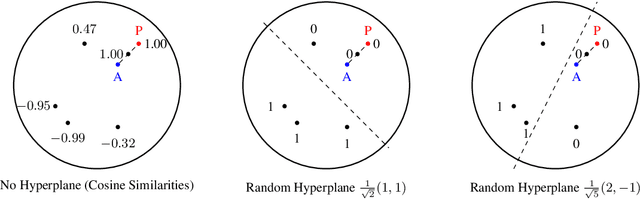
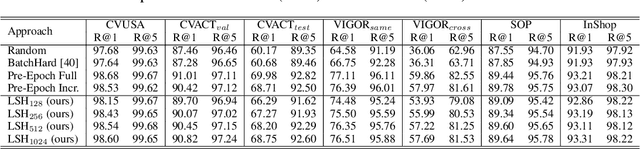

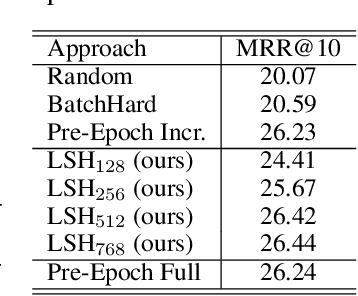
Contrastive learning is a representational learning paradigm in which a neural network maps data elements to feature vectors. It improves the feature space by forming lots with an anchor and examples that are either positive or negative based on class similarity. Hard negative examples, which are close to the anchor in the feature space but from a different class, improve learning performance. Finding such examples of high quality efficiently in large, high-dimensional datasets is computationally challenging. In this paper, we propose a GPU-friendly Locality-Sensitive Hashing (LSH) scheme that quantizes real-valued feature vectors into binary representations for approximate nearest neighbor search. We investigate its theoretical properties and evaluate it on several datasets from textual and visual domain. Our approach achieves comparable or better performance while requiring significantly less computation than existing hard negative mining strategies.
Multi-Layer Gaussian Splatting for Immersive Anatomy Visualization
Oct 22, 2024
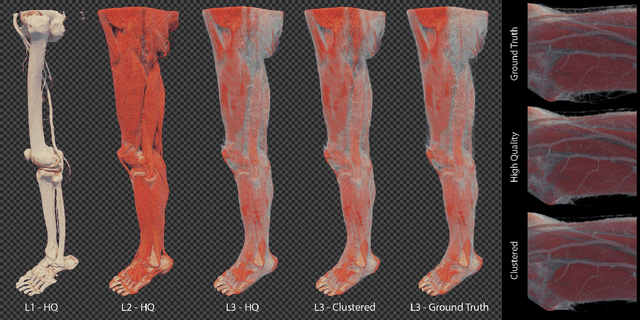
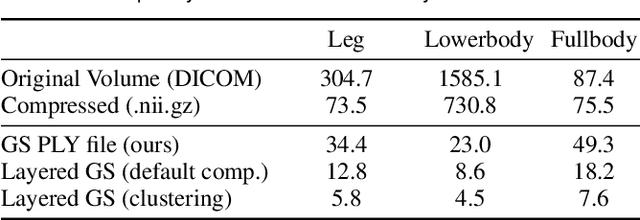
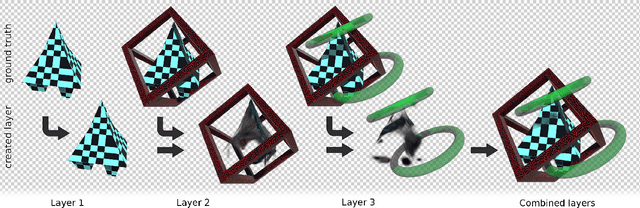
In medical image visualization, path tracing of volumetric medical data like CT scans produces lifelike three-dimensional visualizations. Immersive VR displays can further enhance the understanding of complex anatomies. Going beyond the diagnostic quality of traditional 2D slices, they enable interactive 3D evaluation of anatomies, supporting medical education and planning. Rendering high-quality visualizations in real-time, however, is computationally intensive and impractical for compute-constrained devices like mobile headsets. We propose a novel approach utilizing GS to create an efficient but static intermediate representation of CT scans. We introduce a layered GS representation, incrementally including different anatomical structures while minimizing overlap and extending the GS training to remove inactive Gaussians. We further compress the created model with clustering across layers. Our approach achieves interactive frame rates while preserving anatomical structures, with quality adjustable to the target hardware. Compared to standard GS, our representation retains some of the explorative qualities initially enabled by immersive path tracing. Selective activation and clipping of layers are possible at rendering time, adding a degree of interactivity to otherwise static GS models. This could enable scenarios where high computational demands would otherwise prohibit using path-traced medical volumes.
Semantics-Controlled Gaussian Splatting for Outdoor Scene Reconstruction and Rendering in Virtual Reality
Sep 24, 2024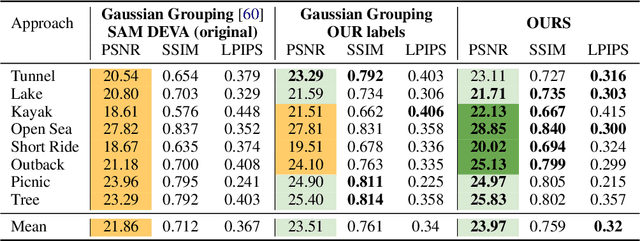
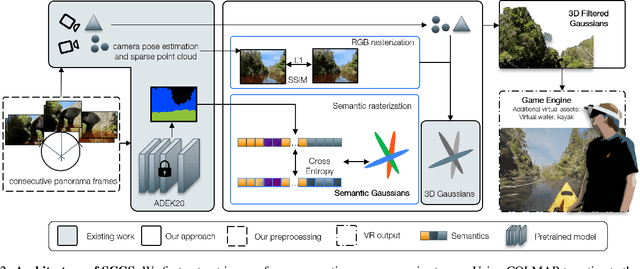
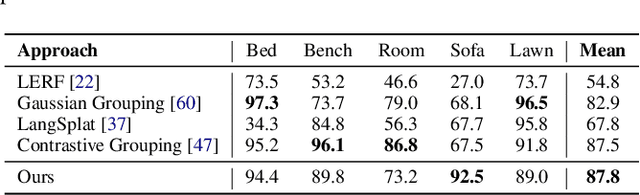

Advancements in 3D rendering like Gaussian Splatting (GS) allow novel view synthesis and real-time rendering in virtual reality (VR). However, GS-created 3D environments are often difficult to edit. For scene enhancement or to incorporate 3D assets, segmenting Gaussians by class is essential. Existing segmentation approaches are typically limited to certain types of scenes, e.g., ''circular'' scenes, to determine clear object boundaries. However, this method is ineffective when removing large objects in non-''circling'' scenes such as large outdoor scenes. We propose Semantics-Controlled GS (SCGS), a segmentation-driven GS approach, enabling the separation of large scene parts in uncontrolled, natural environments. SCGS allows scene editing and the extraction of scene parts for VR. Additionally, we introduce a challenging outdoor dataset, overcoming the ''circling'' setup. We outperform the state-of-the-art in visual quality on our dataset and in segmentation quality on the 3D-OVS dataset. We conducted an exploratory user study, comparing a 360-video, plain GS, and SCGS in VR with a fixed viewpoint. In our subsequent main study, users were allowed to move freely, evaluating plain GS and SCGS. Our main study results show that participants clearly prefer SCGS over plain GS. We overall present an innovative approach that surpasses the state-of-the-art both technically and in user experience.
ASDF: Assembly State Detection Utilizing Late Fusion by Integrating 6D Pose Estimation
Mar 25, 2024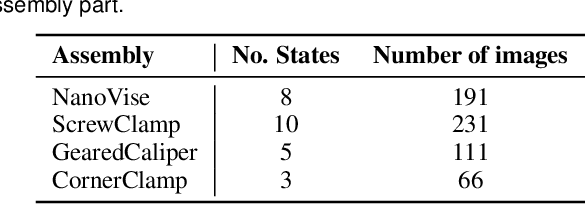
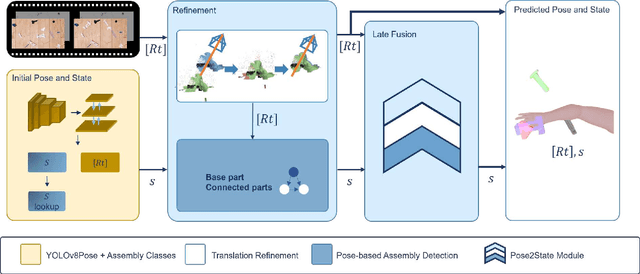

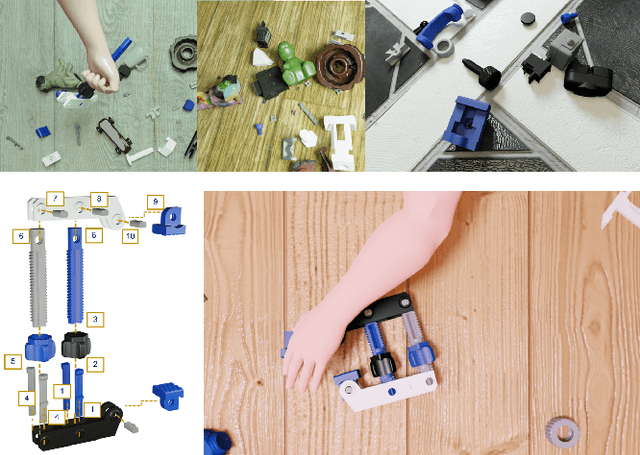
In medical and industrial domains, providing guidance for assembly processes is critical to ensure efficiency and safety. Errors in assembly can lead to significant consequences such as extended surgery times, and prolonged manufacturing or maintenance times in industry. Assembly scenarios can benefit from in-situ AR visualization to provide guidance, reduce assembly times and minimize errors. To enable in-situ visualization 6D pose estimation can be leveraged. Existing 6D pose estimation techniques primarily focus on individual objects and static captures. However, assembly scenarios have various dynamics including occlusion during assembly and dynamics in the assembly objects appearance. Existing work, combining object detection/6D pose estimation and assembly state detection focuses either on pure deep learning-based approaches, or limit the assembly state detection to building blocks. To address the challenges of 6D pose estimation in combination with assembly state detection, our approach ASDF builds upon the strengths of YOLOv8, a real-time capable object detection framework. We extend this framework, refine the object pose and fuse pose knowledge with network-detected pose information. Utilizing our late fusion in our Pose2State module results in refined 6D pose estimation and assembly state detection. By combining both pose and state information, our Pose2State module predicts the final assembly state with precision. Our evaluation on our ASDF dataset shows that our Pose2State module leads to an improved assembly state detection and that the improvement of the assembly state further leads to a more robust 6D pose estimation. Moreover, on the GBOT dataset, we outperform the pure deep learning-based network, and even outperform the hybrid and pure tracking-based approaches.